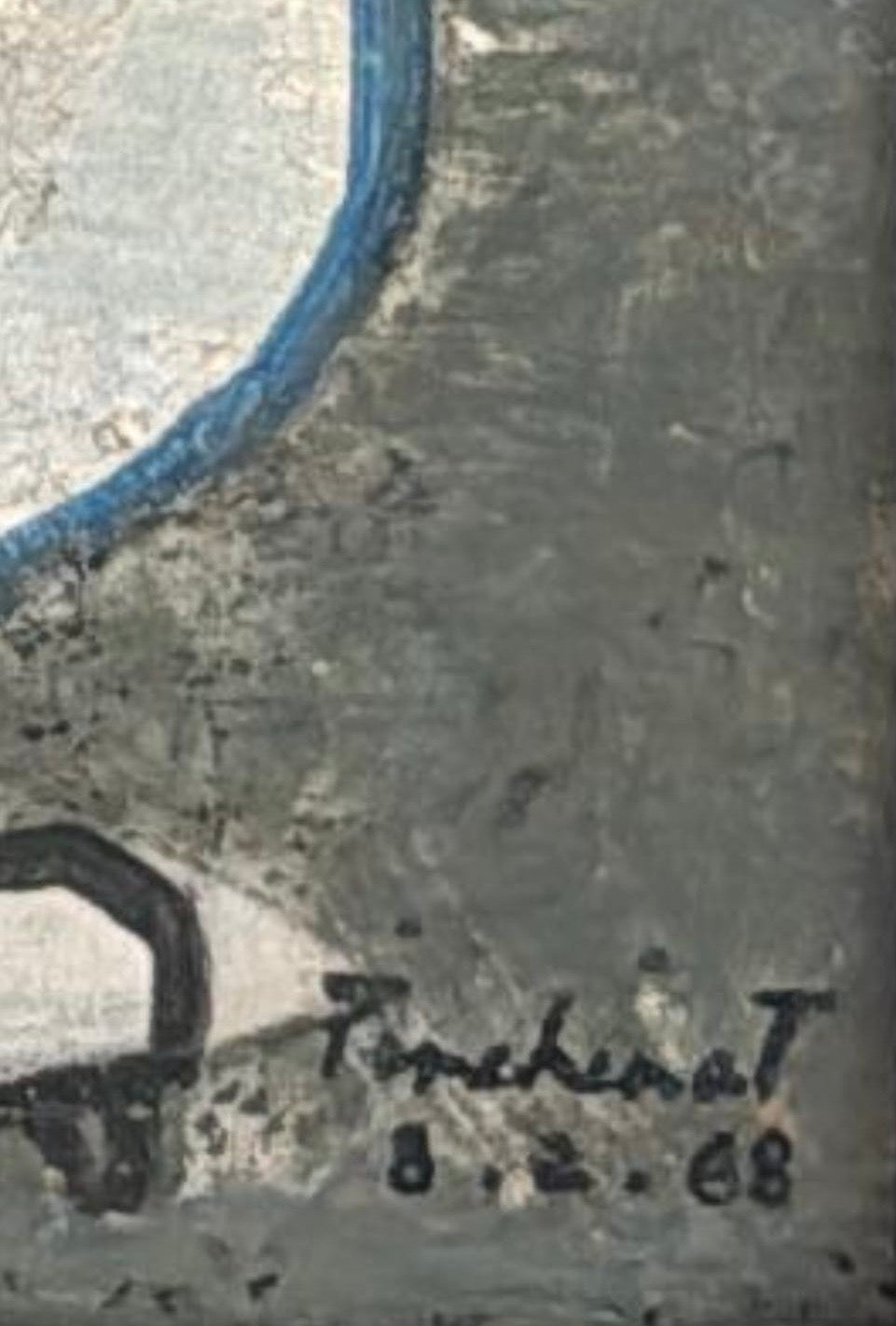
Max Pinchinat 36"x24" Abstract Composition 1968 Oil on Canvas Unframed Painting-Collector's Item- #1GN-HA
Max Pinchinat 36"x24" Abstract Composition 1968 Oil on Canvas Unframed Painting-Collector's Item- #1GN-HA
Regular price
$0.00
Regular price
Sale price
$0.00
Unit price
per
Shipping calculated at checkout.
Couldn't load pickup availability
Certificate of Authenticity Included
Description
Description
Max Pinchinat’s Abstract Composition (1968) is a rare, collector-grade Haitian modernist work that balances raw energy with refined structure. Interlocking geometric forms and sweeping contour lines move across a softly layered ground of grays and greenish tones, punctuated by crisp blue and warm orange accents that activate the surface. The confident black linework creates a rhythmic, architectural framework, while translucent passages and subtle texture reveal the artist’s nuanced handling of paint and space. Striking yet sophisticated, this painting offers exceptional versatility for contemporary interiors and is an important acquisition for collectors seeking mid-century Haitian abstraction beyond the expected figurative canon. The artwork includes provenance, and a Certificate of Authenticity will be issued by Myriam Nader Haitian Art Gallery upon purchase.
About this artist
About this artist
Max Pinchinat was a Haitian painter, critic, and cultural figure born in Port-au-Prince on June 24, 1925. After a brief military career reaching the rank of sub-lieutenant, he joined the Centre d'Art in 1947 and won a gold medal at the 1949 International Exhibition in Port-au-Prince. A leading voice in Haitian art criticism, Pinchinat wrote for Le Nouvelliste and Notre-Temps and co-founded the Foyer des Arts Plastiques in 1950, serving as its first president. In 1951, he relocated to Paris on a French government scholarship, eventually settling there permanently. Pinchinat exhibited across Haiti, France, the U.S., Mexico, and Germany between 1949 and 1961. Critic Gérald Alexis credits him with blending modern sensibility with Haitian popular art traditions, cementing his place in the history of modern Haitian painting. He died in November 1985.